
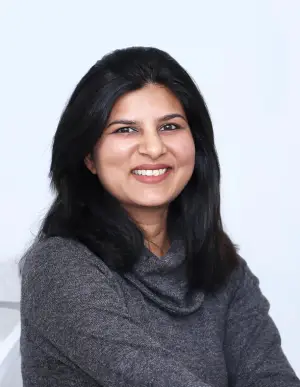
Bachelor of Architecture, Kamla Raheja Vidyanidhi Institute of Architecture, Mumbai, India | Master of Arts in Advanced Architectural Design, Städelschule Architecture Class, Frankfurt, Germany | Doctor of Philosophy, University of Melbourne, Australia
Ishita Chatterjee is an architect and urban designer who worked in India and China before joining academia. She is an Associate Professor at the Jindal School of Art and Architecture and holds a PhD from the University of Melbourne. Her work focuses on informal urbanism, housing justice, spatial justice, ecological debt, politics of knowledge and epistemic justice.
She co-authored the book Atlas of Informal Settlement: Understanding Self-Organized Urban Design and advocates for in-situ upgrading and land rights for residents of informal settlements. She has received international grants, including the Antipode Foundation’s Right to the Discipline grant in 2023 for her work on Urban Natures and Informal Settlements: Resisting Coercive Environmentalism and Forced Evictions, and the Urban Studies Foundation’s Seminar Series Award in 2025 for her project Epistemes of Non-Dominant Inhabitation: A Seminar Series for Early-Career and Under-Represented Scholars to Decentre Urban Knowledge.
She has been an active participant in social movements on housing rights in India. Her writing has been published in international academic journals and media platforms, including The Wire, Outlook, Scroll, The Leaflet, The Bastion, The Conversation, Progressive City blog, and LSE blogs. She has also been interviewed by Hindustan Times, NDTV, and 3CR community radio in Melbourne.
Housing, Planning and Policy
Architectural Obsessions
Architectural Atelier - Rethinking Rehabilitation Housing
Urban Economic Systems
What is research?
Wiley Prize 2021 best paper for the article ‘Rising inequalities, deepening divides: Urban citizenship in the time of COVID-19’ in Geographical Research, 2022
Epistemes of non-dominant inhabitation: a seminar series for early-career and under-represented scholars to decentre urban knowledge, Urban Studies Foundation Seminar Series Award, 2025
Urban Natures and Informal Settlements: Resisting Coercive Environmentalism and Forced Evictions, Right to the Discipline Grant, Antipode Foundation, 2023
2025
Chatterjee, I. (2025). Informal settlements: An entanglement of shifting landscapes, precarious geographies and contested territories. In Sengupta, U., & Nielsen, K. B. (Eds.), The Politics of Urban Land in South Asia Current Challenges and New Directions. Routledge. (pp.68-91) https://doi.org/10.4324/9781003530664
Chatterjee, I. (2025). Organizing During Forced Eviction in Khori Gaon. In Baker, R., & Ferrer, A. (Eds.), Dispatches from the Threshold: tenant Power in Times of Crisis. Fernwood Publishing.
Butcher, S., Shafique, T., Recio, R., and Chatterjee, I. (2025). Epistemic Justice and the University: Reclaiming the Academy for Emancipatory Urban Praxis. International Journal of Urban and Regional Research. DOI: 10.1111/1468-2427.13303
2024
Chatterjee, I. (2024) ‘We pollute, you pay: Forests, bastis and environmental injustice in India’. The Leaflet. https://theleaflet.in/we-pollute-you-pay-forests-bastis-and-environmental-injustice-in-india/
2023
Dovey, K., Shafique, T., van Oostrum, M., Chatterjee, I. & Pafka, E., (2023). ATLAS OF INFORMAL SETTLEMENT: Understanding Self-organized Urban Design. Bloomsbury Publishing.
Recio, R. B., Wolff, W., Alam, A., Routray, S., Gaisie, E., Marin-Toro, A., Chatterjee, I. and Islam, N. (2023) ‘Book Review: Urban citizenship in the global south: Critical reflections on the tactics and counter-tactics of the urban poor’. New Zealand Geographer. https://doi.org/10.1111/nzg.12353
Dovey, K., Pafka, E., Shafique, T., van Oostrum, M., & Chatterjee, I., (2023) Informal settlements are where cities are made. Pursuit.
2022
Chatterjee, I. (2022) ‘No city for Khori Gaon residents: Forced eviction during a pandemic in the name of forest conservation’. Radical Housing Journal. Vol 4(2). (pp.111-137). https://doi.org/10.54825/JALK6985
Recio, R., Chatterjee, I., Lata, L.N., Dongal, N., (2022). ‘Whose vision, which city? Planning and unseeing in urban Asia’. In Bobic, N., & Haghighi, F. (Eds.), The Routledge Handbook of Architecture, Urban Space and Politics, VOL I. Violence, Spectacle and Data (1st ed.). Routledge. (pp.76-93) https://doi.org/10.4324/9781003112464
Chatterjee, I. & Kastia, A. (2022) ‘Community toilets in Shivaji Nagar are inadequate and unevenly distributed’, Citizen Matters. https://mumbai.citizenmatters.in/shivaji-nagar-requires-toilets-designed-based-on-the-needs-of-the-community-42858
Chatterjee, I. (2022) ‘How Bulldozers Dehumanise The Urban Poor’, Outlook. https://www.outlookindia.com/national/how-bulldozers-dehumanise-the-urban-poor-news-195958
Chatterjee, I. (2022) ‘Behind the façade of forest conservation lay one lakh displaced residents of Khori Gaon’, The Bastion. https://thebastion.co.in/politics-and/environment/urban-ecology/behind-the-facade-of-forest-conservation-displaced-residents-khori-gaon/
2021
Chatterjee, I., & Shafique, T. (2021) Denial of the Ordinary. In Hislop, K., & Lewi, H., (Eds) Proceedings of the Society of Architectural Historians Australia and New Zealand: 37, What If? What Next? Speculations on History’s Futures (pp.411-418). Perth: SAHANZ, 2021.
Chatterjee, I. (2021) ‘How Khori Gaon Residents, Now Facing Eviction, Were Forgotten During the Pandemic’, The Wire. https://thewire.in/rights/how-khori-gaon-residents-now-facing-eviction-received-no-help-during-the-pandemic
Menon, M. & Chatterjee, I. (2021) Why the Haryana Govt Must Not Evict One Lakh Residents of Khori Gaon, The Wire. https://thewire.in/urban/khori-gaon-haryana-urban-poor-eviction
2020
Dovey, K., van Oostrum, M., Chatterjee, I., & Shafique, T. (2020). ‘Towards A Morphogenesis of Informal Settlement’. Habitat International, 104, 102240. Doi:https://doi.org/10.1016/j.habitatint.2020.102240
Dovey, K., Shafique, T., van Oostrum, M. & Chatterjee, I. (2020) ‘Informal Settlement is Not a Euphemism for ‘Slum’. International Development Planning Review, (pp.1-13).
McLaughlan, R., & Chatterjee, I. (2020). ‘What works in the architecture studio? Five strategies for optimising student learning’. The International Journal of Art & Design Education, 39(3), (pp.550-564).
Chatterjee, I., Sabri S., & Aschwanden G., (2020). ‘Urban data and its role in creating and addressing inequity’. In De Souza, R. (Ed.), Data and inequity: Who’s missing in big data? (pp. 36 -43).
Chatterjee, I. (2020) How Mumbai’s poorest neighbourhood is battling to keep coronavirus at bay. The Conversation. https://theconversation.com/how-mumbais-poorest-neighbourhood-is-battling-to-keep-coronavirus-at-bay-137504
Chatterjee, I. (2020) In Mumbai’s Shivaji Nagar slum, an NGO is helping six lakh residents keep Covid-19 at bay. Scroll.in https://scroll.in/article/962562/in-mumbais-shivaji-nagar-slum-an-ngo-is-helping-six-lakh-residents-keep-covid-19-at-bay
Recio, R., Chatterjee, I., Lata, L.N., (2020) COVID-19 reveals unequal urban citizenship. LSE COVID-19 blogs. https://blogs.lse.ac.uk/covid19/2020/06/05/covid-19-reveals-unequal-urban-citizenship-in-manila-dhaka-and-delhi/